
What customer service tone actually means and why it matters
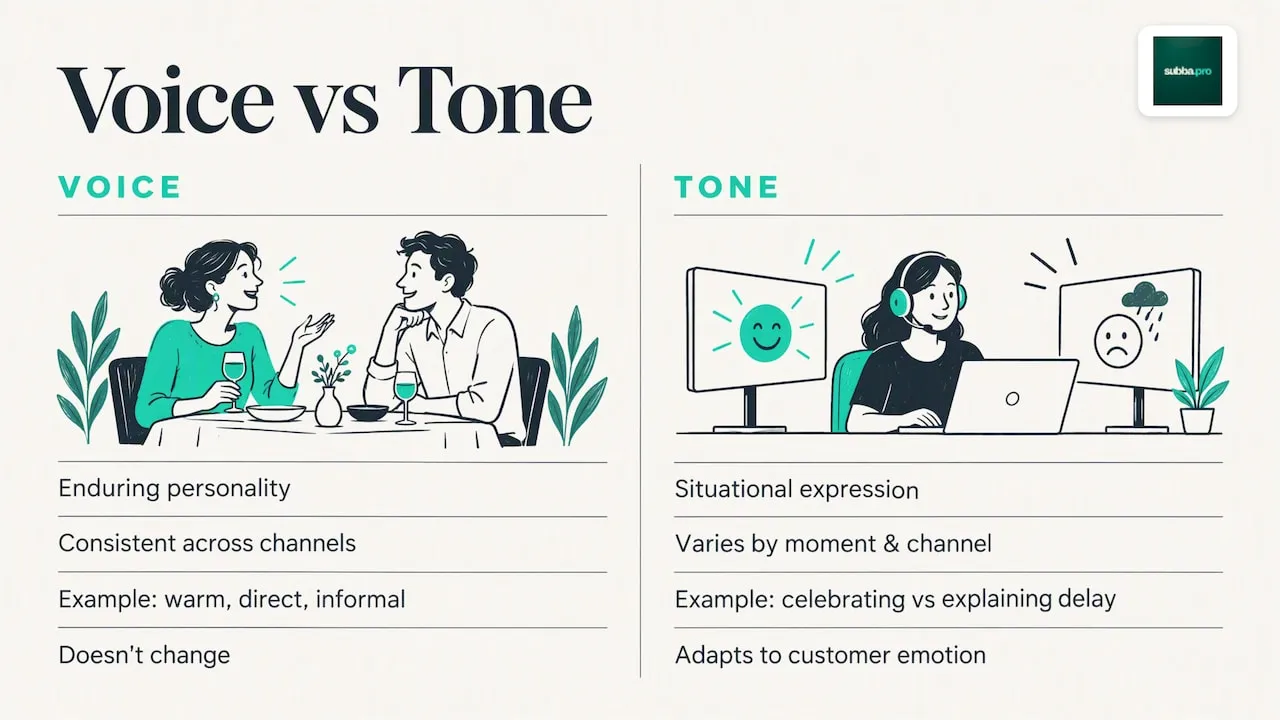
Brand voice is the personality that stays fixed, think friendly, formal, playful. Tone is how that personality flexes moment to moment: warmer when a customer is anxious, more direct when you're solving a technical problem. Getting this distinction right changes how teams write scripts and train staff, because a single "customer service voice" document without situational guidance leaves agents guessing.
Research into real conversations backs this up. Agents who use warmer, more affective language at the start and end of a call and shift to competence-focused, cognitive language in the middle see measurably higher satisfaction than those using a flat tone throughout.
This sequencing effect matters for three outcomes:
- CSAT scores: satisfaction rises when warmth bookends problem-solving rather than replacing it.
- Retention: customers who feel heard early stay more patient through a difficult fix.
- Perceived professionalism: competence-led middle sections signal that you know what you're doing, not just that you're pleasant.
A step-by-step method to define your customer service tone
Most teams skip straight to writing scripts. That's backwards. Build the foundation first, then the language follows naturally.
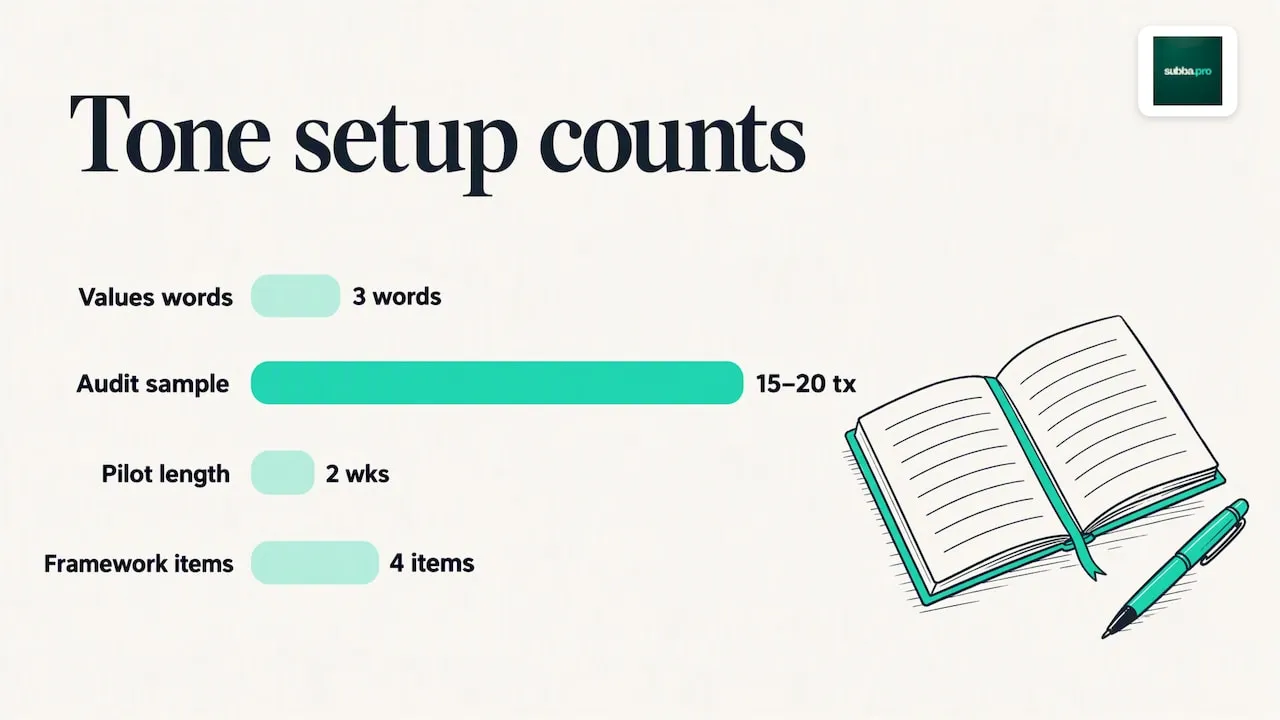
- Clarify your values. Write down three words that describe how you want customers to feel after contacting you, not how you want to sound.
- Define your audience. A dental clinic and a tradesperson's customers expect different levels of formality; note the age range, urgency level and typical concerns of yours.
- Audit current conversations. Pull 15 to 20 real transcripts across phone, chat and email from the last month.
- Build a lightweight framework. Document opening language, middle-of-conversation language and closing language separately, plus any channel-specific rules.
- Pilot with one team or channel. Test the framework for two weeks before rolling it out everywhere.
- Iterate using real feedback. Adjust based on what agents find awkward to say and what customers respond well to.
When you run the audit, sample moments, not whole conversations. Score the opening line, the problem-resolution section and the sign-off separately, because sequencing research shows these stages carry different weight for satisfaction. A flat average across a whole transcript hides where tone actually breaks down.
Your finished framework doesn't need to be long. A single page covering four things does the job: a warm opening line template, two or three competence-signalling phrases for the problem-solving middle, a warm closing line, and any channel rules (for instance, chat allows more brevity than email).
Pro Tip: Score openings and closings separately from the problem-solving middle when you audit calls. The two sections need different language, so grading them together hides exactly where tone breaks down.
Ready-to-use phrasing for phone, chat, email and social
Here's language your team can drop straight into templates.
Warm openings (use at the start of nearly every interaction): "Thanks so much for reaching out, I'm happy to help with this." Competence-focused openings (use when a customer is already frustrated and wants speed): "I can see what's happened here, let's get this sorted."
For the problem-solving middle, swap vague reassurance for specific action: "I'm processing your refund now" lands better than "I'll sort that for you." During escalations, neutral, procedural language works best: "I'm passing this to our specialist team, who'll follow up within one working day."
Empathetic phrasing has a measurable effect here too. Analysis of social-media customer care conversations found that an empathetic tone significantly reduces negative customer emotion, such as frustration and sadness, while a more passionate, enthusiastic tone increases satisfaction.
Channel adjustments matter as much as the words themselves:
- Chat: keep sentences short, drop formal greetings, match the customer's pace.
- Email: prioritise clarity and structure over warmth, since tone is harder to read in text.
- Phone: lead with warmth, since vocal tone carries more emotional weight than wording alone.
Training your team and your AI tools to hold the tone
A one-page tone guide only works if people actually use it. Short, repeated practice beats a single long training session.
- Run micro-training sessions of 10 to 15 minutes, focused on one tone element at a time (openings, then closings, then escalation language).
- Use role-play with real transcripts from your own audit, not generic scripts, so agents practise your actual tone, not a textbook version.
- Keep a one-page reference guide at every desk or pinned in your team chat for quick checks during live calls.
The decision rule is simple: warmth at the start, competence in the middle, warmth again at the close. Teach this sequence explicitly rather than hoping it emerges naturally.
If you use AI for any part of your customer replies, the same triage logic applies. Experimental research comparing human and AI-led service recovery found that AI was seen as competent in routine, low-emotion cases, but its human-like language triggered negative reactions in emotionally charged ones, especially once people knew it was AI. Use AI for bookings, confirmations and routine replies, and build in a clear handover to a person for complaints or anything emotionally charged.
Pro Tip: Keep a running list of phrases agents find awkward to say out loud. If nobody uses a line from your guide after two weeks, rewrite it rather than enforcing it.
Measuring and refining your tone over time
Tone is easy to set and easy to let slip. A small set of recurring metrics keeps it visible.
- CSAT: track by channel, not just overall, since tone drift often shows up in one channel first.
- Sentiment trend: watch for a gradual dip even when CSAT looks stable.
- First contact resolution (FCR): competence-led middle sections tend to improve this.
- Escalation rate: a rising rate can signal that opening warmth isn't landing.
| Metric | What it tells you | Suggested review cadence |
|---|---|---|
| CSAT by channel | Where tone is working or failing | Monthly |
| Sentiment trend | Early warning of drift | Monthly |
| First contact resolution | Whether competence language is effective | Monthly |
| Escalation rate | Whether opening tone is defusing frustration | Quarterly |
For audits, sample 15 to 20 conversations per channel each month and score openings, middles and closings against your one-page framework separately, rather than giving each transcript a single overall mark. When you want to test a change, such as a new opening line, run it with one team for two weeks and compare CSAT and sentiment against the rest of the team before rolling it out everywhere.
Common tone consistency issues and quick fixes
Most tone problems repeat across teams. Here are the five we see most often, with a one-line fix for each.
- Guides nobody reads: pin the one-page framework where agents already work, not in a shared drive they forget about.
- Templates that drift from the brand: review and update templates every time the framework changes, not just when someone complains.
- Tone shifting between channels: apply the same opening and closing principles everywhere, adjusting only length and formality per channel.
- Scripts that sound robotic: replace rigid scripts with phrase options agents can choose between, so responses sound human.
- No training after onboarding: schedule a short refresher every quarter, not just once when someone joins.
Run a quick monthly check: pull five recent transcripts per channel, score them against your framework, and flag anything that reads flat or inconsistent.
How an AI receptionist can help apply your tone consistently
Keeping tone consistent gets harder as enquiry volume grows, especially across phone, web chat and booking forms running at once. We built our AI receptionist to write in the business owner's own tone and style, from the details they give it, so replies sound like you wrote them rather than a generic script.
- Drafting before automation: review and approve AI-drafted replies to your contact forms before switching to full automation, so you keep control of tone from day one.
- Routine tasks handled automatically: bookings, reminders and quick replies run 24/7, freeing your team for complex or emotionally sensitive conversations.
- Escalation built in: in web chat, anything the AI can't answer confidently is passed to you by email, and on the phone line a caller who sounds upset or asks for a person is offered a message for you or, when you're open, a transfer to your phone (if you've added a number). It doesn't spot emotion in written enquiries, so keep your contact form on drafting mode if complaints come in that way.
Brand voice versus customer service tone: what's the actual difference
These two terms get used interchangeably, which causes real confusion when teams try to write guidelines. According to industry guidance on the distinction, voice is the brand's enduring personality, the consistent character that shows up in every piece of communication, from your website copy to your out-of-office reply. Tone is situational: how that same personality gets expressed differently depending on context.
A useful way to picture it: your voice is how you'd describe your personality at a dinner party, warm, direct, a bit informal. Your tone is how that personality shows up differently when you're celebrating good news with a customer versus explaining a delay. The voice doesn't change. The tone does.
This matters practically because teams often write one "tone of voice guide" and expect it to cover every situation. It can't. A guide that only defines voice (friendly, professional, approachable) gives agents a vague target without telling them what to actually say when a customer is angry, confused or in a rush. A proper framework separates the two: one section on voice (who we are, always), and a second section on tone (how that shows up differently by moment and channel).
Getting this right also prevents a common failure mode: agents who are consistently "on brand" in personality but wildly inconsistent in appropriateness, cheerful when a customer is complaining, formal when a customer wants quick reassurance. Voice sets the character. Tone makes it fit the moment.
Handling difficult conversations and complaints
Complaints are where tone consistency matters most and slips most easily. The instinct under pressure is to either over-apologise or become defensively formal, and both erode trust.
The sequencing principle still applies, but the stakes are higher. Open with acknowledgement, not an apology script: "I can see why this has been frustrating" lands better than a rehearsed "We're sorry for the inconvenience." Move into the competence-focused middle quickly: state what you're doing, not what you feel. "I'm checking your order now and will have an answer in two minutes" does more work than extended reassurance.
The UK National Occupational Standard for customer focused service, part of what it calls the "impression and image" side of customer service, asks staff to choose communication styles that meet each customer's needs, using words they can understand, and to recognise when a customer is angry or confused and adapt their behaviour. That's especially relevant in complaints, where a template response reads as dismissive even when the words are polite.
Close complaint conversations with a concrete next step and a warm sign-off, never just a resolution statement. "I've processed your refund, and I'll check in on Thursday to confirm it's landed" closes the loop and rebuilds warmth after a difficult middle section. Avoid passing a complaint between agents without context. Each handover should carry a one-line summary of where the tone currently sits, so the next person doesn't restart with a mismatched register.
Tone as a scalable advantage
Tone gets harder to control exactly when it matters most: as you add channels and staff. The businesses that treat it as a documented system, not a personality trait, scale without losing what made customers trust them in the first place.
A simple seven-day channel audit, five transcripts a day from your busiest channel, often reveals more drift than you'd expect.
Roland
Keeping your tone consistent with subba
Documenting a tone framework is one thing. Applying it to every enquiry, at every hour, is another. Our AI receptionist replies in your business's tone, warm and friendly by design, across web chat, contact forms and, with the phone add-on from £29.99 a month, calls. You can review its contact-form replies before going fully automated, so you can check the warmth and the substance before anything goes out on its own.
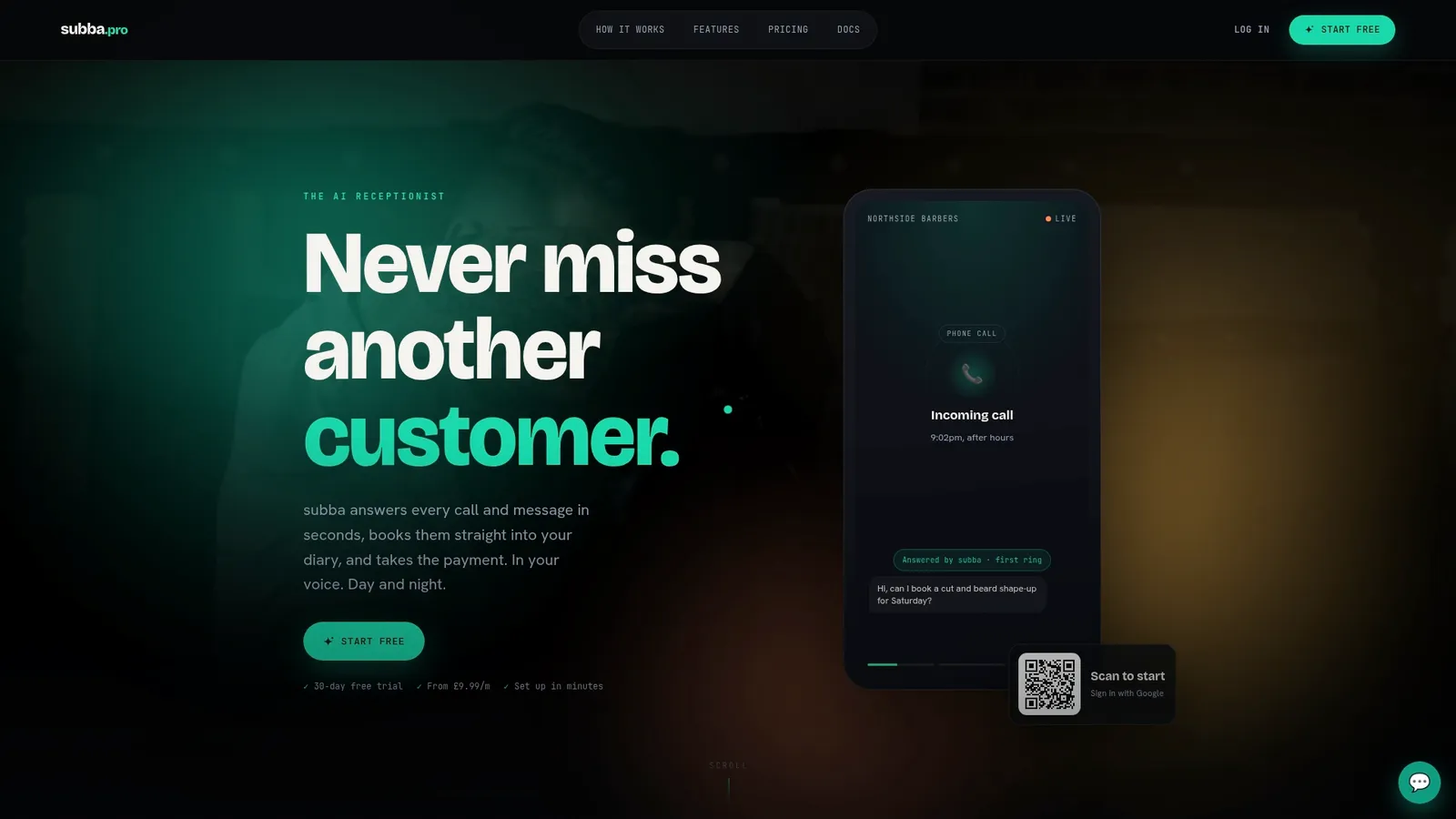
If you're weighing this up for your own business, start by checking our pricing plans, which start at £9.99 a month on Starter, to see which tier matches your enquiry volume. A short pilot, drafting mode first for your contact form, full automation once you trust the tone, is the easiest way to see whether it fits before committing.